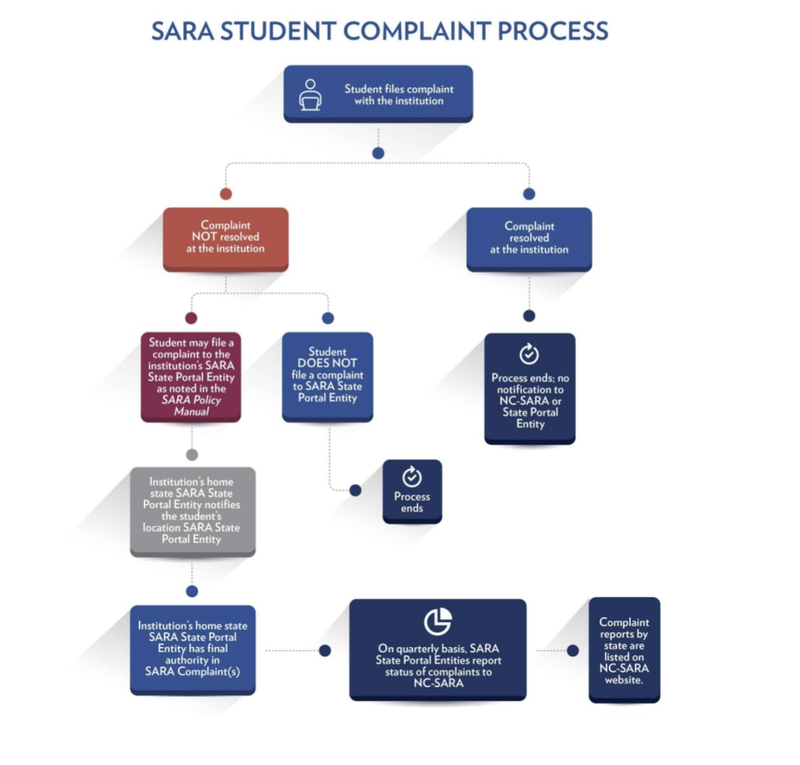
In addition to the above-referenced process, York College has a policy for student complaints regarding online programs. The National Council for State Authorization Reciprocity Agreements (NC-SARA) is a private non-profit organization of which York College is a member. NC-SARA consumer protection provisions require the institution's home state, through its SARA State Portal Entity, to investigate and resolve allegations of dishonest or fraudulent activity by the state's SARA-participating institutions, including the provision of false or misleading information. Examples of fraudulent activity include the following:
- Veracity of recruitment and marketing materials;
- Accuracy of job placement data;
- Accuracy of information about tuition, fees, and financial aid;
- Complete and accurate admission requirements for courses and programs;
- Accuracy of information about the institution’s accreditation and/or any programmatic/specialized accreditation held by the institution’s programs;
- Accuracy of information about whether course work meets any relevant Professional Licensing requirements or the requirements of specialized Accrediting Agencies;
- Accuracy of information about whether the institution’s course work will transfer to other institutions; and
- Operation of distance education programs consistent with practices expected by institutional accreditors (and, if applicable, programmatic/specialized accreditors) and/or the C-RAC Guidelines for distance education.
A student has the right to lodge a complaint or grievance. York College is committed to ensuring that all student concerns and complaints are addressed without prejudice and resolved promptly. Student complaints relating to consumer protection laws offered under the terms and conditions of the State Authorization Reciprocity Agreement (SARA) must first be filed with the institution to seek resolution.
The student should begin the complaint process with the institution, i.e., York College. If the resolution is not found, the student will contact the institution's home state, SARA State Portal Entity. To this end, a student should initiate any complaint with the department Chair overseeing the online program. The complaint should also go to the Dean of the School, who oversees the department and program. The Dean and the Chair will meet with the student and the leaders of the relevant program to gather information and resolve the complaint by ending any offending actions within or by the program. Students wanting to appeal the Dean's decision can appeal to CUNY Central by contacting the following office:
City University of New York
Office of Student Advocacy and Referral
205 42nd Street
New York, NY 10017
studentaffairs@cuny.edu
If no resolution occurs at this level, the student can take their complaint to the New York State Education Department (NYSED) – except for complaints about grades or student conduct violations – within two years of the incident about which the complaint is made. Students can read the NYSED complaint procedures online. You also can contact NYSED at the following address: New York State Education Department, Office of College and University Evaluation, Supervisor of Higher Education Programs, 89 Washington Avenue, Albany, NY. 12234, (518) 474-1551, IHEAuthorize@nysed.gov Please review the SARA complaint process for more information.
New York State Education Department’s complaint procedures